High way robbery

Author Archive

  1. High way robbery

    December 16, 2009 by Christopher Buxton


    English street robbers, Somali pirates, Bulgarian highwaymen, every nation has its criminal stereotype and in the pre-Christmas crime wave, the Crocodile brothers have grabbed the attention of the headline writers of the Bulgarian yellow press.


    For the past twenty years, impervious to attempts by the authorities to put them behind bars, or perhaps helped by them, the band led by the brothers, Kroky and Geyser Milev, have preyed on Turkish guest-workers returning from Germany and Austria. Perhaps alerted by paid informers among customs officials and border police, the gang await their prey on the Sofia ring road or on the motorway that stretches past Plovdiv towards the Turkish border. They sit in cars down adjoining slip lanes, till they spot the loaded Audi or Mercedes, then give chase with flashing police lights. Once the law abiding Turkish citizen stops, the gang jump out of their cars, dressed in police uniforms, ready to beat smash rob and even kidnap.

    With former police chief, Boyko Borisov as Prime Minister, many corrupt customs officials and border police are supposed to be trembling for their futures. Not a day passes without news of an arrest of some high powered official – even former minister. But the legal system has not as yet delivered convictions. As Boyko once famously said in his former life: we arrest them; you judges release them. Despite many previous arrests and trials, the Crocodile gang still operate with apparent impunity.


    And so we learn that after a shoot out on the SofiaPlovdiv motorway and the release of a frightened handcuffed Turkish Audi driver, the brothers are still at large armed with Kalashnikovs. No doubt after a hue and cry they’ll be arrested and once again the faulty Bulgarian justice machine will judder into life – just in time for our heroes to stand for an election and claim immunity. Alibis will be provided as in the past. The outcome will be in doubt for the next few years.


    The Crocodile gang are but the latest in an old Bulgarian criminal tradition, celebrated in story and song. The country’s mountain chains and forests have long provided shelter for gangs of highway robbers, known as Haiduks. Most notably during the time of Turkish rule, Haiduks preyed on the rich caravans travelling from the northern borders of the empire towards Istanbul.


    It was inevitable that many of the Haiduks have been celebrated as heroes of national resistance to oppressive Turkish rule. Captain Petko Voivoda, is just one of countless typical examples of Robin Hood characters who used the proceeds of their robberies to found churches and build bridges and fresh water fountains.

    The romance associated with Balkan brigandage gained an international reputation with the kidnapping of the American missionary, Miss Stone in 1901. Her colleagues managed to smuggle the ransom in gold under the noses of the Turkish authorities. They had no doubt that the gold would be used to fund the Bulgarian resistance movement. As the American newspaper proprietor S.S McClure reported: “We never suspected the Bulgarian brigands of bad faith, for brigandage is one profession in which the prosperity of a man’s business absolutely depends upon his scrupulously keeping his word.”


    Miss Stone told the New York Times on her release: “I suppose you want to hear all about the brigands. They were not quite so fierce as you think.”


    I’m not sure that our victim of the Sofia-Plovdiv motorway robbery would have been so gracious. The evidence shows that a large majority of Haiduks were not selfless patriots, fighting for Bulgarian freedom, but like the Crocodile brothers, out for get-rich-quick easy pickings from hapless travellers.


    In England, every government is held to account by its yellow press when the street robbery statistics come out. Bulgarians won’t be holding their breaths on the fate of the Crocodile brothers.

  2. In memoriam Nikola Vaptsarov

    December 11, 2009 by Christopher Buxton

    Just returned from London and a recital inspired by the late Adrian Mitchell. Such a radical poet – I wonder if he’d known about his Bulgarian kindred spirit. Too late to find out now.

    Anyway to celebrate one hundred years since his birth, I’ve translated three of Vaptsarov’s poems – ones I like very much.

    Vaptsarov was born in Bansko, worked in a foundry, where he wrote the only work published in his lifetime – Engine Songs. His commitment to Communism in the thirties led him to be involved in wartime resistance to the government of Tsar Boris. He was arrested and shot in 1942. Boris canvased opinion among literary circles but was assured by the great and good that he was not ordering the death of a great Bulgarian poet.

    Inevitably Communist Bulgaria turned him into a hero. Fortunately his genius still burns in the postcommunist hangover.

    Spring in the Factory

    She wanted to clock on with the first shift

    But the engine swore

    furiously

    “Oh no you don’t

    I’m in charge here

    Where will we end up without rules?

    ‘Ere – go ask the doorman!”


    But she was right cheeky

    And she didn’t ask the doorman. –

    Slipped in.

    Opened some window up high

    And hidden from the engine

    Stuck out her tongue.


    And straight off a machine sang out.

    But the workers

    Were all fingers and thumbs.

    Realising who was causing this

    The engine said:

    “I’ll chuck her out!”

    – Chuck her out really? Mockingly

    Growled

    A good iron mixer.

    – Just try, whirled the chattering stirrer,

    We’ll come out on strike for her.


    The engine shut up. The wind carried

    From somewhere

    Warm breath of black earth

    A melody – broad and joyous –

    And steps

    Of cracked

    Feet.


    Those who sometime had

    Dug

    The earth, snorted like horses,

    And the others, windows thrown open,

    Glowed before

    The blue

    Heaven.


    The ticker tape machine shot out

    Something rude.

    A girl happily sang

    A boy shot her

    With a loving glance

    And she blushed.


    Just then the doorman came in quiet

    And demanded

    “Who’s snuck themselves in without my say-so?”

    But he soon caught on, smiled guiltily

    Combed his hair

    Whistled

    And then shut up.

    Farewell

    To my wife

    Sometime I’ll come into your dreams

    Like an unexpected, unwanted guest.

    Don’t leave me outside on the street –

    Don’t bolt the doors against me.


    I’ll enter on tip-toe. I’ll approach so gently

    I’ll narrow my eyes to see you in the dark

    And when gorged with gazing at you –

    I’ll kiss you and then be gone.

    Chronicle

    In The Krup Factories grenades pour out

    Pack them up snugly! They’re made for us, mates,

    They’ll drink up our blood out in the meadows

    Pack them up snugly! Millions of us…


    At Bayer they’ve found some kind of gas

    From a new mix. And it’s just for us

    It’ll just eat up our sooty lungs

    It couldn’t be clearer…Don’t you want to puke?


    At Vickers, they’ve bored machine gun muzzles

    To shoot six hundred bullets a minute – for us.

    So they can bang it into our thick skulls

    Come on cheer up! Come on cheer up!


    Come on cheer up! Don’t think how

    The storm will catch us, the dark will smother us.

    Present arms to the front of our modern era

    But please…a bit of hush! But please…

    No grumbling


  3. Arrived in Antarctica

    November 30, 2009 by Christopher Buxton


    I am feeling the brisk slap of a minus 40 degree blizzard this morning – and all from the comfort of my Colchester back room where I sit tapping the keys and watch the relentless Essex rain.

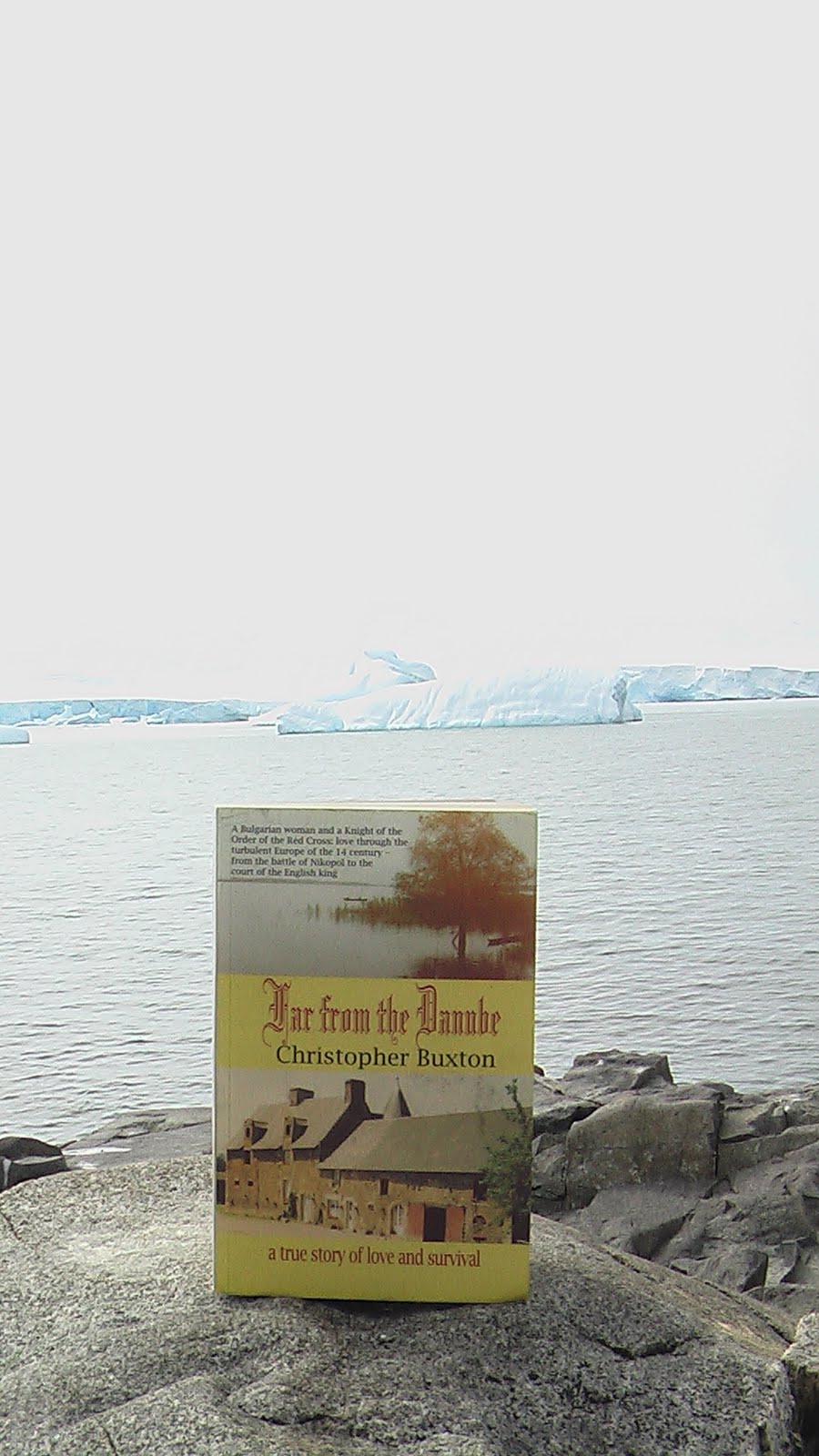
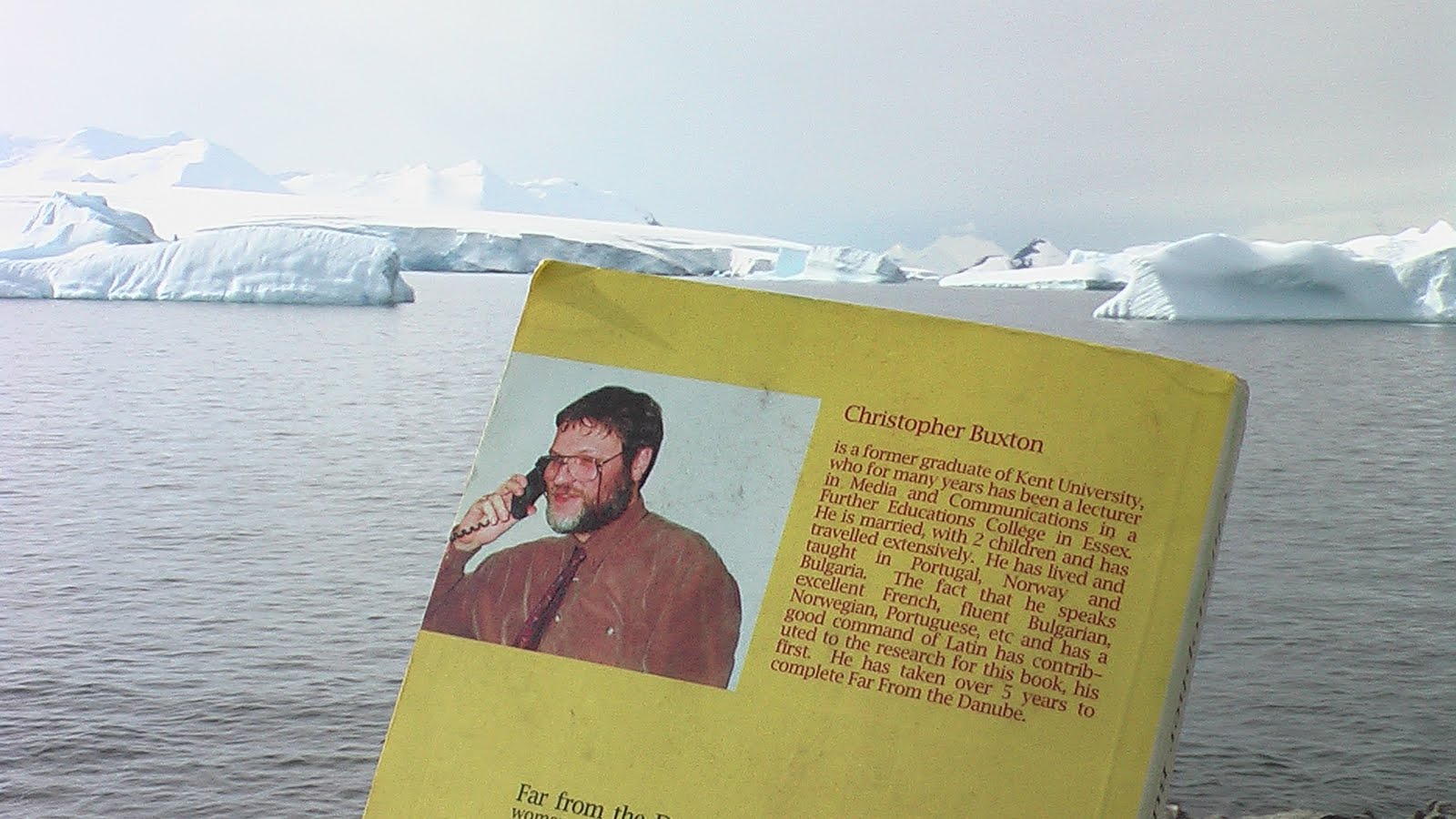
    Chris Dobrowolski, artist in residence in Antarctica, has sent me a picture of my book with ice floes in the background. I feel absurdly honoured. For a writer, seeing one’s book in such an unlikely place is like a sudden vision of Bishop Berkely’s tree.

    If you remember, Berkely was obsessed with the problem of perception and existence. If an object’s existence depended on its being seen, how could we be sure that a tree existed in the middle of an unpeopled desert?

    The answer is of course that it is perceived by God – or in the case of my book by Chris Dobrowolski.

    My only regret is that there are no penguins.


  4. Bulgaria 2009

    November 27, 2009 by Christopher Buxton

    What I learnt in Bulgaria this summer

    1.
    Penyo Penev, the manic depressive young poet of Stalinist Bulgaria, should now be remembered for his secret verse. Forget about his celebrations of factory routine and five year plans. His obscene verse is quintessentially Bulgarian and puts him up with Rabelais. Here is his terse summary of a Bulgarian survival strategy.

    When the violets flower
    And nothing is going your way
    F**k everyone else’s mother
    And make sure you are OK

    F**ck everyone else’s mother
    And stop yourself feeling blue
    And if you are still feeling bothered
    Go f**k your own mother too.

    Anyone interested in a translation of his epic Kuncho Putkoderov can contact me direct via e-mail.(sozopol456@yahoo.com) Warning: this celebration of Balkan virility is extremely brutal if taken at a literal level. It also besmirches the names of illustrious class enemies like Churchill and Eisenhower.

    2.
    Bulgarian elections throw up the most unlikely candidates. Everywhere in Burgas posters lined the metal fences of building sites. In one a fat bald man with a simpering grin demanded More for Burgas. In another, a fierce unshaven man pointed his finger at me with the slogan Hey ’nuff Shame! Neither man represented any of the major parties and therefore had about as much chance of getting elected as Screaming Lord Such. One turned out to be an ex-football boss who has managed to put off a charge of causing death by drunk driving for ten years. The other used to be described as the fist of Ataka – the far right nationalist party. Following the beating of a driver on the Trakia motorway, he fell out with his boss. Both candidates turn out to be the detritus thrown up by the turbulent sea of judicial failure. They had their weeks of street poster attention; but neither man was rewarded by the votes he believed he deserved.

    3
    Galvanized by the unfair neglect of Bulgarian writing on the world’s literary stage, I have begun re-reading the classics – starting with Wolf Hunt by Ivailo Petrov and Gold Mine by ST. L. Kostov. Kostov’s plays have a really contemporary ring – like Armando Ianucci without the swearing. Wolf Hunt has to be one of the greatest novels written in Bulgarian. In Koprivchitza I doused myself in the sad life of the poet Dimcho Debelyanov. Here is a translation of his last poem just before his brain was blown away on the south eastern front in 1917

    Orphan Song
    If I die in this war
    Regret will sting no-one.
    I lost my mother; but I wedded
    No wife; and I have no friends

    But my heart does not grieve –
    I live, an involuntary orphan,
    And maybe Death waits for me
    Bringing comfort in victory.

    I know my hapless path.
    My wealth is stored within,
    For I am rich in sorrows
    And in joys unshared.

    I shall depart this world
    As I entered it – homeless,
    Tranquil as the song that
    Shores up needless memory


  5. Yovkov, you should be living at this hour.

    November 19, 2009 by Christopher Buxton

    Turkish serials outsoaped by Bulgarian Reality

    A phone call from Bulgaria has alerted me to the fact that a single story has distracted the populace from its panic about Swine Flu. It has even supplanted Turkish Soap Operas in peoples’ imaginations. It is a story of village passion worthy of the pen of Yovkov.

    A modern Romeo and Juliet – the headlines scream below the mastheads of even the most pretentious newspapers. Successive days have provided pictures of only one of the main protagonists – a blonde sixteen year old whose beauty rivals that of her fictional namesake, Albena.

    In Yovkov’s story the fate of the doomed beauty provokes swiftly changing extremes of emotion from her neighbours.

    The real Albena, only child of the Mayor of Knyazhevo, has provoked an even wider range of reaction, having clasped her fifteen year old boyfriend in her arms as together they threw themselves into the path of a slow moving but unstoppable freight train.

    What initially captured the imagination of millions of readers was the fact that while Albena was a promising pupil at the Economics Gymnasium in Vratsa, her boyfriend was a gypsy. In America he would be described as coming from the wrong side of the tracks. Actually just a field separates Knyazhevo from Dyankovo and its gypsy quarter, and it appears that over the summer, Albena crossed that field and fell in love with Tsvetan.

    Interestingly though there have been many pictures of Albena, I have yet to see a photograph of the “handsome” Tsvetan in any newspaper. This may reflect a disquiet among Bulgarian editors. By all means milk this Romeo and Juliet story for all it’s worth but let’s not have a picture of a gypsy on our front page.

    References to doomed love abound. It turns out that Albena’s father had crossed the field to retrieve his daughter from her boyfriend’s hovel, whither his daughter had fled. It is alleged that supported by a cousin, he had entered Tsvetan’s home, threatened to kill Tsvetan, grabbed Albena and dragged her home.

    The contrast between the two families could not have been starker. Tsvetan is the youngest of five in a family where no-one has regular paid employment. Life is grim. His mother travels to Sofia to beg. Tsvetan has been in trouble for breaking into empty houses and stealing property. “Dirt poor – what else could you expect?” The Dyankovo Mayor is quoted as saying, while at the same time expressing her sympathy for her colleague, Albena’s father.

    “What would you do if your daughter wanted to marry a…..?” is a recurring fantasy topic of conversation throughout the world. It can allow for unrestrained racism and assumptions of patriarchal power. As we know in the UK, such speculation can light the touch-paper for so called “honour killing”, when a father wakes to the reported reality of his daughter’s unsuitable relationship.

    This summer in Bulgaria I suddenly found myself out of my Guardian reader’s comfort zone. I was sitting at a table loaded with goodies, drinking rakia with friends, listening to the good natured banter. Into this came a story – Stoycho’s daughter was going to Africa on a business trip. Stoycho told her – hey, don’t you come back with a black boyfriend ‘cos you know what I’ll do. I’ll take him on a hunting trip. Cue knowing laughter from everyone.

    Like the villagers in Yovkov’s story Albena, local feeling, reported in newspapers, sways violently between sorrow for the doomed lovers and sympathy for the position of Albena’s father. Tsvetan still struggling for his life in the local hospital perfectly fits the racist stereotype of thieving gypsy. His family is currently desperately trying to raise the money necessary for operations on his crushed hands and brain trauma. However villagers have told reporters it would be better if he died and joined Albena in Heaven, where perhaps God would look more kindly on a love between a blonde beauty and a gypsy.

    So for a while, people can wallow in the sentimental glow occasioned by the fate of “star crossed lovers”. The story is not likely to change entrenched attitudes however. As good people travel to work they’ll read the latest crime stories, pass the Graffiti calling for Gypsies to be boiled down to soap and tut-tut over the problem of its impoverished minority.