Sorry – if you were tempted by the stunning offer of a flat with views of the Wonderful Rocks, in Aitos and were just getting ready to e-mail us an offer, you’re too late. The flat was sold two days ago.
The State Savings Bank in Burgas has made a giant leap forward in customer relations. Previously I had written about the invisible line between two pillars, behind which a large crowd had to jostle, waiting the nod of a grandfatherly ex militia man towards one of the three tellers avalable for customers. Now this ex militiaman, who was not averse to manhandling clients who stepped across the line or sharply ordering customers to stop making jokes, is relaxing outside the bank. His job of marshalling customers has now been taken over by a ticket machine. Relying on experienced customers to explain the near incomprehensible options to novices, our man can relax in the sun, secure in the knowlege that despite waiting times of up to an hour, and the frequent preferential treatment offered to those with connections, the customer will stand or sit in stoic silence. Such is the result of successful conditioning.
There have been few developments to report on A Bulgarian Story. Only that Cherie Wolf received a threatening letter from Burgas Council, which contained curiously contradictory statements – that there was no danger of her building falling down, but that in the event of some unforseen major incident, there might be. When approached for clarification, Burgas Council asked why Cherie hadn’t paid for her own expertise to counter that paid for by Mr Dimo Podlev. The answer to this is obvious. Dimo Podlev has loadsa money to pay for Professor Doshko and Architect Boshko and Cherie has not. So for now, progress on this has halted. Cherie’s tenants continue to believe in the building and Cherie awaits Mr Podlev’s return from holiday.
Once upon a time, two old ladies were presented with a large house in the middle of Burgas. It had been restored to them following the fall of Communism. Let’s give them non Bulgarian names to protect the innocent. Cherie Wolf and May Shepherd.
Cherie’s father, Jack, had built the substantial house in the late 1930s. It consisted of three floors, an attic and cellars. Beaten and tortured till he was yellow, Cherie’s father had seen all his lands and buildings confiscated in the name of the people in the late 40s.
So you can imagine Cherie’s excitement when after years of poverty and discrimination, she and her sister-in-law, May, were handed the title deeds of her father’s old house. In spite of some internal damage and difficult tenants, the house was in good condition, which was as well since Cherie had no money for expensive repairs.
May sold her half of the building to a large Russian firm, whose boss is now in a Siberian prison. But in spite of the little street filling up with black sedans and shaven headed wrestlers, Cherie was determined to keep her share of her father’s house. It still has her father’s name carved into the stone entrance slab. Cherie had seen enough of the harsh new world of crashing banks to know the security of property. So with a minimal pension and significant care needs, Cherie let her half – a shop/fast food outlet on the ground and two offices on the second floor. After time Cherie found she had enough money to share in the repair of the roof.
Meanwhile – as happens in these cutthroat days, the Russian boss fell foul of the new Putinocracy and the enormous firm was split. A Bulgarian firm with Russian connexions took over the other half of the building.
Its boss was and still is Mr Dimo Podlev. Dimo, a sharp economics graduate, son of a Communist General and protege of the one time party elite, became the boss of one of the richest companies in Bulgaria. We have given him a Bulgarian name to protect the guilty. He was obviously very talented but it took more than talent and ruthlessness to get where he now is. He is sparing and modest in his speech. He told me that “above him there is only God.”
Mr Goshko Rutzov was and still is Dimo’s main man in Burgas. He inhabits the towering hotel Dimo has bought and looks like a Roman Emperor. While Dimo is slight and prickly, Mr Rutzov is effusive and stuffed with social niceties. His office is packed with expensive presents from grateful clients. He acts with the confidence of a man with photos of his yacht on his office wall. But he has been seen to grovel in front of important Russians in the hotel foyer.
A year ago Mr Rutzov became very concerned about the state of the shared building. Suppose it was to fall down! Over the last year he has spent thousands on more and more “experts” to prove the building dangerous. He even tried to bill Cherie after the event – to pay for experts she had never heard of.
A commission from the town hall came to inspect the building and despite tremendous pressure from a perspiring Mr Rutzov could find nothing wrong.
This did not stop the morally responsible Mr Rutzov from sending Cherie’s tenants expensively produced reports from his paid experts to impress upon them the need to evacuate the dangerous building. His aim through sensational graphics was to scare the tenants away and cut off Cherie’s only source of income.
Behind all this lurked Mr Dimo Podlev, his desire to have the 1920s building knocked down and have in its place a prestigious modern block which would be entirely under his control. Last year he and God sent Cherie an ultimatum. Either sell to him or agree to take a 25% share of the new building but lease all control of that share to him. Cherie consulted with her friends and came up with a counter-proposal. This was met with six months of silence. Mr Podlev had very important negotiations in Israel.
In the last two months Mr Rutzov has brought in commission after commission. Cherie sits in her badly repaired flat, not knowing what will happen next as neither Mr Rutzov nor Dimo Podlev feel the need to talk to her – the sole surviving child of the house that Jack built. Who gains the most from this? Why lawyers of course. A frightened Cherie has consulted a lawyer and now has to find 2,000 leva.
My mum seemed perfect in every way. Immaculate in person and in her housekeeping. If I close my eyes I always seem to see her in a pretty print frock, sitting darning by the radio in one of the many flats we lived in.
With Dad’s long hours – I remember the shock once of finding him in the bath with his beard shaved off – a lot of my early childhood was just me and my beautiful mum.
In Coventry we’d get on the top floor of a double decker bus and go to Leamington to feed the ducks in the park. In my dreams she would run away from me towards the park gates and the main road. But in reality she was always there. She was a good runner though. She was quite bitter about coming second in the Mum’s race.
In Nottingham when I was ill she lit the fire in my stone flagged bedroom and giant bear shadows roamed the room till she calmed me with stories from King Arthur.
Every evening we’d listen to the Archers – she never listened to it after Nottingham.But I remember the fire at Arkwright Hall.
I remember running out into the garden at Prenton, pursued by Grandma with a tape measure – only because Mum had told me not to allow Grandma to make me any clothes.I hid in the hedge.
She read me all the children’s classics with all the voices.By the time we got to Oxford she’d graduated to Dickens.
In Oxford summer always seemed to come early.She rigged up a washing line in the garden and she taught me to play tennis.After school, we’d often go to Port Meadow, where she taught me to swim in the Thames.When she was sure I could do it, she watched me cross the river and back.A yachtsman continuously cut across my path, thinking it a big joke.Mum stood at the bank in her print cotton dress, ready to dive in and save me.
Skinless sausages and baked beans, liver and bacon, curry with sliced fresh banana on top, pork chops with apple and rosemary – my favourite meals after school along with fruit yoghurt bought in pots from over the Banbury Road – a different flavour to try every day.
Mum was a patient and kind disciplinarian, teaching me with words that it was wrong to eat all the babysitter’s sausages and stab all the oranges with my newly acquired scouting knife.
The first love of my life was Sabrina with a mother as seemingly chaotic as my mother was ordered. Sabrina and I quarreled over which Mum was the poorest. This could only be settled by going through their purses.My mum proved the richer by £1 and fourpence. So that was settled. My mum snorted when she found out and convinced me to my Dickensian satisfaction that our family had the honour of being by far the poorer.
Mum taught me my catechism – it was just like learning lines.Faith is a supernatural gift of God that enables us to believe without doubting whatever God has revealed. And she accompanied me to every obligatory church service including the packed rain soaked smelly St Chad’s Cathedral in Birmingham. When later I stopped going and lost all confidence in organised religion, it was as if she had done her duty by me and she never visited a church again.
Holidays in a caravan in Devon, where cows licked our bathing suits, their rasping tongues by the washing line keeping us awake during the night.
My mum hated Birmingham.The racist greengrocer called her love and asked if she wanted company when Dad was away.Once she was propositioned outside a cinema near Digby waiting for me to see Dr Strangelove.I would come home from my hell of school to the damp cavernous flat and have nothing to do except read. Mum suggested to Dad he did something with me.And so came our first real bonding – on the long walk to the Hawthorns and the long bus ride to St Andrews.
Mum spent one holiday when she was not working reading me Gormenghast.
I didn’t buy a guitar to punish my ma.
My years of teenage rebellion were directed at my incense heavy school, encouraged by Mum’s increasingly revolutionary take on the world.
I used to listen to Pick of the Pops in the breakfast room in quiet isolation – because I thought Mum and Dad didn’t like pop music.Though I discovered in London Mum did like Tom Jones – but she worried whether he would keep his voice. When we had our first gramophone they bought me some Shadows records.
She wasn’t too keen on my long hair though but only raised the subject when I was at my most vulnerable – in the bath.
She was very caring about my teenage angst. Though I was very protective in the information I gave her.
So my engagement came as a shock.I phoned the news from a public telephone cabin in Bulgaria.There was a pause.What colour is her hair?A reasonable question – but one difficult to answer.Kind of brown but it gets blonde in the summer was my typically male response after looking through the cabin window to check.
I call these memories non-theatrical because Mum and Dad belonged to an exclusive club that I was on the fringes of. Mum only had one friend in my memory who was not in the business. And that proved a harum- scarum aberration with wild excursions way outside my mother’s comfort zone.
All these memories only provide clues to an intensely private and fascinating person.Over this year I have gazed often at her ever changing face and to her expressive hands.There was so much more to know: so much more to find out.
My auntie Billie (the tomboy of the family) has written a letter full of wonderful memories and Dad has read it to Mum – using his magnifying glass, stumbling sometimes over unfamiliar Devon placenames. We think Mum hears it, though her eyes remain closed. Later she moves restlessly and tries to speak. Her mouth is dry so we give her water, poking the straw between her side lips. Two faint words sounding like cake and biscuit are repeated over and over. I so want to dash down to the shop and get some celophane wrapped slice of fruit cake but know that this would likely choke her. She holds her hands and new incoherent phrases come tumbling out as Dad urges Diction Monica! Articulate those consonants in his best director’s voice.
Two hours we sit spellbound by my mother’s changing face and her attempts to communicate. You have such expressive hands, Monica, says Dad.
Suddenly three questions emerge clearly from Mum’s lips: Where am I? What am I doing here? Where am I going? In the face of these unanswerable questions it is easier to retreat to the now open treasure chest of memories.
Mum hardly remembers Torquay – her birthplace – and as a child I feel we always seemed to deliberately avoid it as a place that had been irredemably spoiled. But the story of Billie riding in the removal van from Torquay to Exeter was always a fixture in family memories – as were the bicycles lined up outside the house for Sunday excursions. These memories are so visual that they seem to become my memories too – except of course I see the actors as much older in the way I knew them. So on that ill fated bicycle excursion when it bucketed with rain, I can still see the drip drip drip of water falling from Grandad’s cap onto his nose and his silent resignation – the memory so vivid as if I were there, though of course it stars the older Grandad I knew.
Do the banisters in the Exeter house still bear my mother’s teethmarks? The pleasures of a large family is that there is always an aunt or uncle ready to spill the beans on the naughtiness of your parents. The inconvenient misdemeanours of an only child can remain a frustrating secret for his or her children. Though I expect Auntie Billie could tell a tale about how Peter and I disappeared for an entire Sunday morning only to be found by Uncle Reg in his car touring the Woolston foreshore.
Auntie Billie mentions Dad driving a sporty little car. I must have been very young then. I never associated Dad with sporty cars.
Billie’s picnics though were always the stuff of family legend – it was as if she brought a magic hamper on every trip. I can just imagine us tucking into such a spread on the floor of the Whiteparish cottage after trip to Nomansland was rained off.
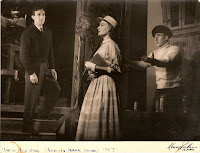
My mother, Monica Stewart, is a an actress. In her latest role – a one hander co written by God and Samuel Beckett (posthumously) – she is playing herself: dying.
It is as ever an overwhelming performance and we who sit in the wings strive to understand its complexity.
My mother who was never comfortable being herself now looks like a famine victim. Her eyes are permanently shut. Her arms are now her chief tools of expression, reaching out, grasping, pushing away. As if her deaf ears can now hear her family’s voices, she moves spasmodically – especially to poetry and song. Sometimes it seems she is feeling sharp pangs of pleasure or pain and her lips move as if trying to tell us something. But all that emerges is the occasional cry that baffles the audience and keeps them on the edge of their plastic seats over the two hours of visiting time.
Mum, we want to know what is happening in that dark hallway you now inhabit. It is what every human wants to know. And it is why we take these hours as a performance – guessing, wishing, hoping.
Dad has brought your pictures to the ward, and the nurses whisper in temporary respect. Look, Monica was an actress.What remarkable photos!
Dad is the Director, now powerless to control the action. This quiet woman holds the centre of the stage.